Syndic+: The Why, How, When, and Where I Am Now
A founder’s note on building a SaaS for Quebec condo syndicates — the reasons, the stack, and what I’m asking for next.
A founder’s note on building a SaaS for Quebec condo syndicates — the reasons, the stack, and what I’m asking for next.
I’ve been quietly building Syndic+ for a while now, and I figured it was time to write down what it is, why I started, how it’s put together, and — most importantly — what I’m hoping to do next. If you’re a Quebec syndic admin, a co-owner who’s tired of PDFs in your inbox, or just someone curious about niche SaaS, this one’s for you.
Why
The honest answer: Word, Excel, and email are not a syndicate management system.
That’s how most Quebec syndicates run today. The treasurer keeps a spreadsheet. The president keeps a Word doc with the meeting agenda. The secretary keeps the minutes in a Drive folder nobody else can find. Co-owners get an email blast for the AGA, sometimes a PDF attachment with the budget, and that’s it. Documents drift across personal accounts. Versions multiply. The institutional memory of the building is held together by whoever happens to care most that year.
That patchwork was already fragile. Then Bills 141, 16, and 25 quietly turned condo administration into a regulated activity:
- Bill 141 put insurance, the building envelope, and the water heater registry squarely on the syndicate.
- Bill 16 added a maintenance log (carnet d’entretien), a five-year contingency fund study, and a reserve fund that actually has to match the study’s projections.
- Bill 25 brought Quebec privacy law down on every entity that handles personal data — including syndicates. Co-owner names, addresses, banking info, accommodation requests: all of it now carries documented obligations.
A spreadsheet doesn’t notify you that your maintenance log is overdue. An email thread doesn’t prove that legal notice was sent before a special meeting. A shared Drive doesn’t satisfy Bill 25’s requirement to know where personal data lives, who has access, and what you’d do in a breach.
The why is simple: a dedicated SaaS, not a folder full of files. Something that knows about Quebec condo law, that survives the change of board, and that respects the people whose data it holds.
When
I didn’t wake up one morning with a SaaS idea. I joined the board of my own syndicate, served for about a year, and slowly watched the same problem repeat itself in a dozen different shapes:
- The previous board’s documents were on a USB key. Half the contracts didn’t have a counterparty I could identify.
- Every “where is X?” question went out as an email and came back as “I think the previous treasurer had it.”
- Compliance obligations that turned out to be real legal duties were tracked on a Post-it note on someone’s fridge.
- When a co-owner asked a perfectly reasonable question — ”how is my monthly fee calculated?” — the answer required reconstructing four years of decisions from inbox archeology.
Around month twelve, after a particularly bad meeting where we couldn’t find a contract everyone remembered signing, I went home, opened my editor, and started sketching what would become Syndic+. Not because I thought I’d discovered a market — because I needed it to exist for my own sanity.
The handover. Every. Single. Time
How
A few principles guided the technical choices, and they all trace back to the obligations:
Canadian data residency. Bill 25 doesn’t ban storing data outside Quebec, but it adds disclosure and assessment obligations the moment data crosses a border. For a product whose entire reason to exist is “trust me with your syndicate’s most sensitive records”, the calculus was easy: all data lives on Canadian servers. Database, storage, backups. No exceptions. Co-owner data does not transit through US regions to save a few dollars on hosting.
Security as a product feature, not a launch checklist. Encryption at rest and in transit is table stakes. On top of that: per-organization isolation (every syndicate gets its own scoped tenancy), audit logs on sensitive actions, role-based permissions, optional 2FA and passkeys for board members, OAuth-based integrations rather than password-sharing. Bill 25 also pushed me toward privacy by design in concrete ways — every personal-data field is intentional, every export is logged, every co-owner can see what’s stored about them.
Two front doors: dashboard and portal. Early on I made the call that syndicate admins and co-owners are not the same user. They have different goals, different permissions, and they should not share a UI:
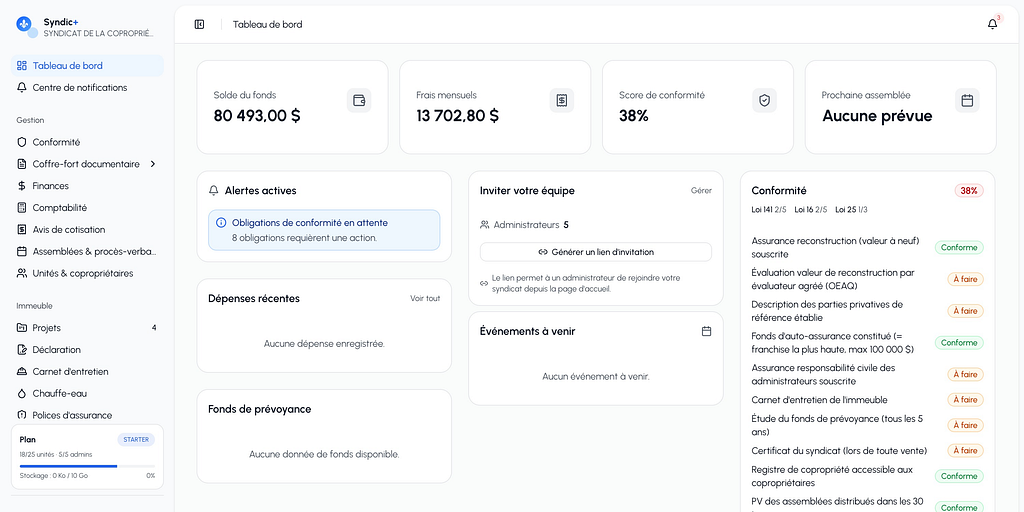
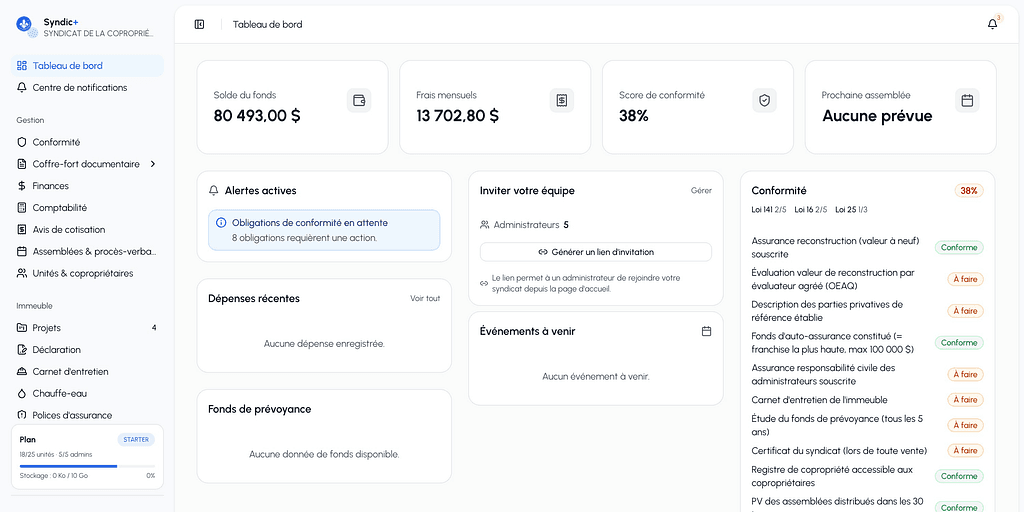
- The dashboard is for the board. It’s where you manage units, finances, meetings, the maintenance log, the document vault, compliance obligations. It’s dense, opinionated, and assumes you have business to do.
- The portal is for co-owners. It’s where you see your own statement, file a request, read announcements, consult shared documents, and get a clear picture of your unit — nothing else. It’s calm by default.
Same database, same auth, two completely different surfaces. The architecture supports it natively rather than crowbarring “co-owner mode” into an admin app.
A modern, boring stack. Next.js 16 on the App Router with cache components, Postgres with a typed query builder, server actions over hand-rolled API routes, shadcn/ui for the design system, bilingual content from day one (French and English, not English-with-a-translation-bolt-on). I’ll write a separate post about the engineering — what cache components actually do to your mental model, why I picked one auth library over another, how the bilingual pipeline works — but the short version is: nothing exotic, everything chosen so that one developer can keep moving.
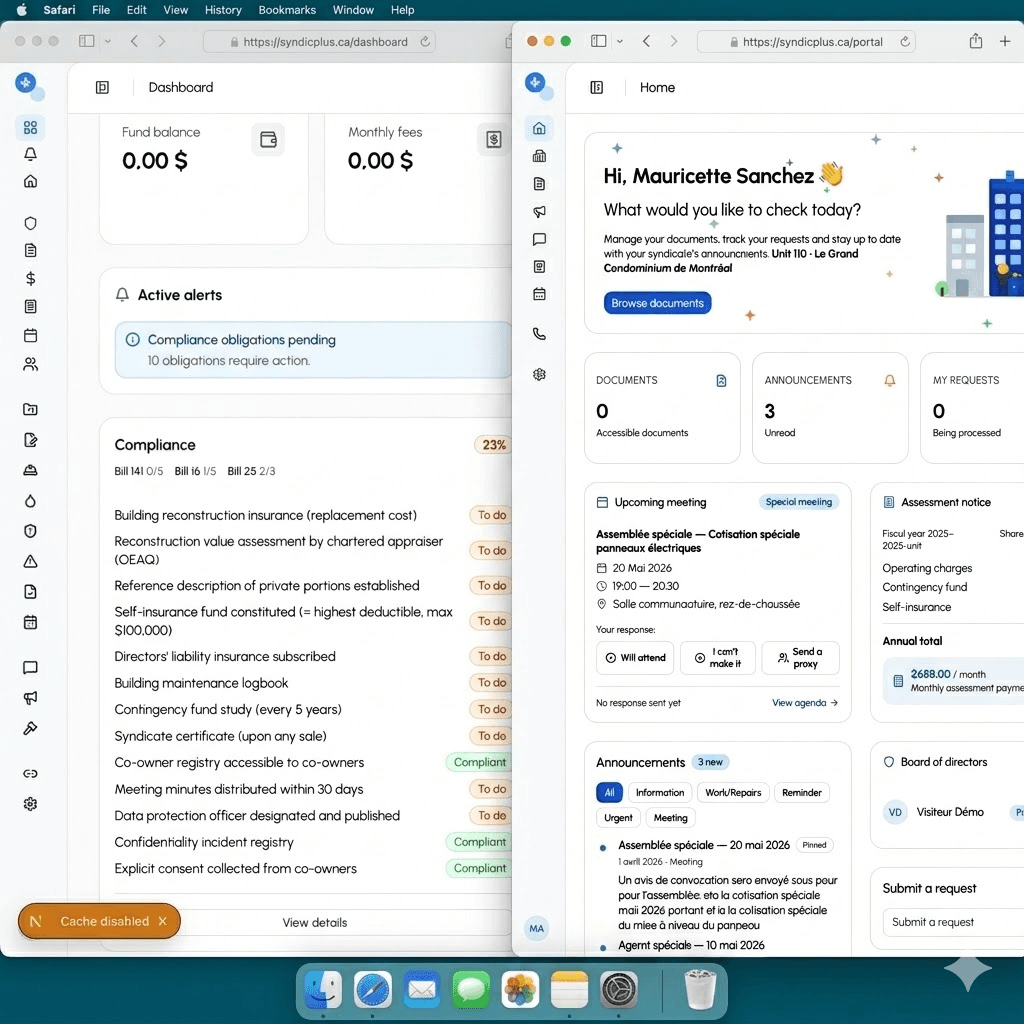
Two front doors: the dashboard for the board, the portal for co-owners
Where I am now
Syndic+ is at the very beginning, and I’d rather say that out loud than pretend otherwise.
What’s working today:
- Compliance — Bills 16, 25, 141 obligations tracked per syndicate, with renewals and evidence.
- Document vault — central, versioned, scoped per syndicate, inherited by every future board.
- Units & co-owner registry — including the water heater registry Bill 141 quietly requires.
- Meetings — AGA, special, and board meetings with minutes and convocations.
- Finances & accounting — fiscal years, assessment notices, contingency and operating funds, chart of accounts.
- Maintenance log** — components, inspections, warranties, with reminders.
- Co-owner portal — read-only statements, requests, announcements, documents.
- Bilingual everywhere — French and English, both first-class.
I’m running it against my own syndicate. That’s the most honest beta I can offer: every quarter when I sign off on the financial statements or send out an AGA convocation, I’m using the product, finding the rough edges, and fixing them.
What I’m asking for next:
More syndicates willing to test. If you’re on the board of a Quebec syndicate and any of this sounds like it would have saved you a weekend last month, I’d love to talk. I’m happy to:
- help you create an account at syndicplus.ca and onboard your existing data,
- walk through which features fit your building,
- open a direct line for issues, requests, and “this would be way better if it did X” feedback,
- prioritize features that real syndicates actually need over ones I imagine they’d want.
This is the part of building a product where momentum comes from talking to actual users, not from writing more code. So if you’ve read this far and you administer (or live in) a Quebec condo, send me a message. I’ll write back.
Syndic+ is at syndicplus.ca. If you administer or live in a Quebec condo and want to try it, reach out.